To make good pasta, you need good durum wheat flour, water, salt and above all, dexterity.
There are three distinct manufacturing methods:
• They are handcrafted (Douida, lsantair, M'hamsa, Berkoukch).
• Rolled out into sheets, the pasta is then cut with a knife (Boufertouna, Drhimate, L'ftat).
• The rolled-out dough is crumbled directly into the sauce (F'tat Ch'tba).
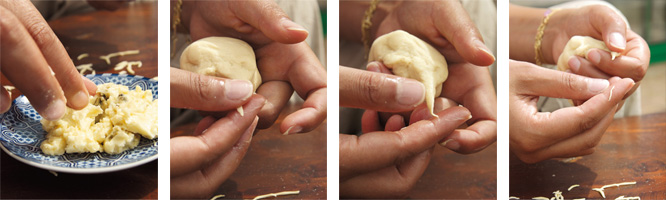
Douida is made from a soft, malleable paste. Between the thumb and forefinger coated with rancid butter or butter, a thin strand of dough is carefully rolled to obtain a very fine vermicelli (Chaâria bel lahlib).
The Douida is then laid out on a sheet where it dries in the shade. It is mainly used in soups, chorbas, seffa and in the famous beldi chicken dish, served at the Night of Destin dinner during Ramadan (Douida be djaj).
Lsantair is made in the same way as Douida (Saffron-infused orzo pasta soup).
The dough, as big as a flattened grain of rice, is rolled between the thumb and forefinger but thinned on the sides like a bird's tongue.
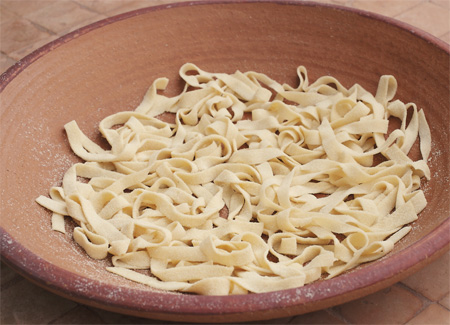
Boufertouna (also called TarechtaThis dish is prepared in several regions of Morocco. The dough is flattened into a thin sheet on a floured work surface and then cut into tagliatelle. They are then left to dry in the open air and shade before being cooked with a chicken sauce.
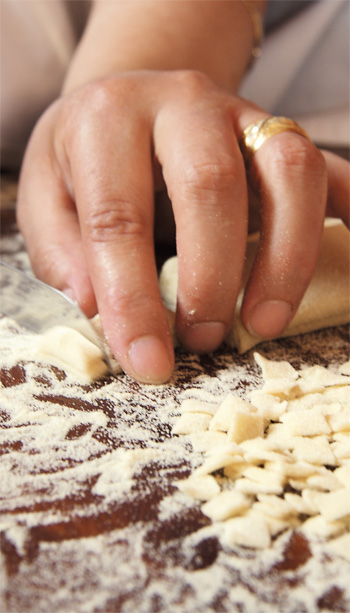
Drihmate
To make Drihmate, the basic process is the same as for Boufertouna. The resulting tagliatelle are then cut into squares and used in the same way as F'daouche in sauce (Chicken giblets F'daouch).
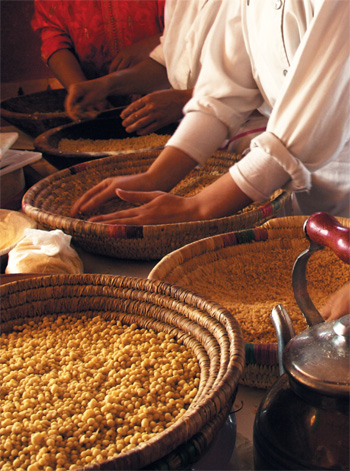
M'hamsa and Berkoukch
Their preparation varies from region to region. To make them, simply moisten flour or semolina (depending on the region) with salted water, sprinkle with flour, and roll by hand to obtain small balls of dough. To size them, the balls are passed through a Boussiyar (a sieve with large holes) or transferred to a Midouna (a flexible utensil made of woven raffia) at an angle, where they are shaken in a circular motion and thus sorted. The largest Berkoukch, almost the size of a chickpea, are found in the Figuig region! Berkoukch and M'hamsa are often cooked with milk for Eid al-Fitr breakfasts (the festival marking the end of Ramadan) or in a sauce with vegetables and meat.
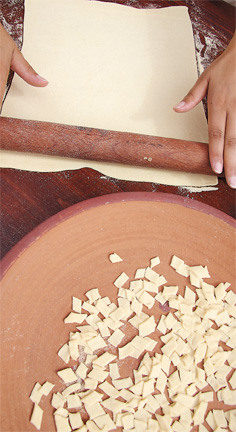
F'tat The name comes from the Arabic word fattata, meaning to crumble. There are two types of F'tat. The first is made from small pieces of pasta cut with a knife. The name of the dish consists of the word F'tat followed by the main ingredient it accompanies (F'tat belhlib, F'tat belhelba, etc.). The second type of F'tat is called F'tat ch'tba*. The dough is spread into a thin sheet and placed on a thorny branch called a ch'tba. The branch is then dipped in broth, and the dough crumbles as it is stirred.
*Ch'tba is a branch from a thorny shrub called sedra (acacia), which is very common in Morocco. Before use, it is carefully cleaned.
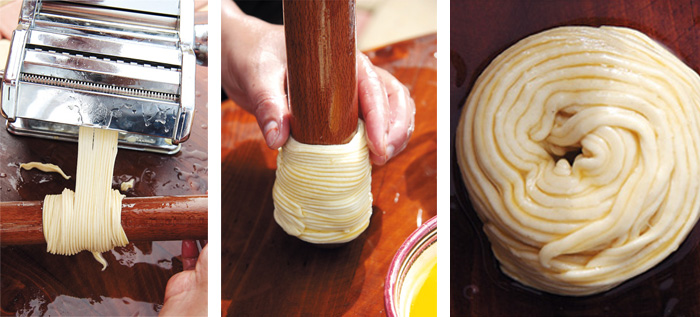
It's impossible to be thorough without mentioning the spaghetti machine, which has become an indispensable utensil in Moroccan kitchens. In recent years, women have repurposed it to facilitate and speed up the preparation of R'zzat El Kadi, a key ingredient in Rfissa del Gharb. This ingenuity has allowed them to save precious time. So much so that it's now very rare to see it made using the traditional method. The spaghetti machine has also enabled the creation of new recipes, including sweet ones like Chebbakia bel hlib.
 The most modern equipment for pasteurization of milk



